Please Fasten Your Seatbelt, Wherever It Is: A Love Letter (With Notes) to the Trotro
The mate said “last stop Nungua.” Then he shouted “Spintex!” From cramped seats to surprise fares, here’s a trotro rider’s honest look at what’s wrong, and how to fix it.
Share
By Selorm Attatsi
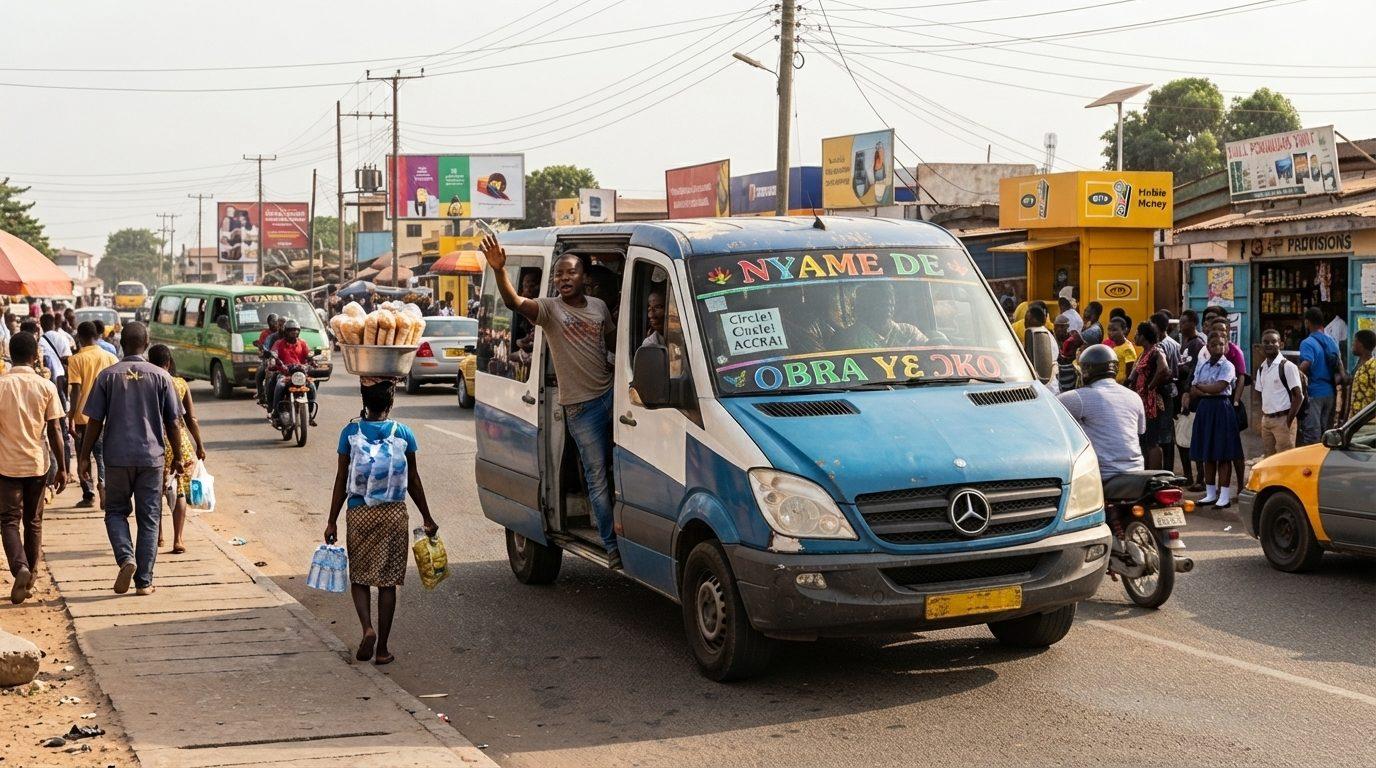
The trotro that pulled up at the Roman Ridge stop didn’t say a word. No board, no shouting, no clue. So I did what any careful traveller does: I asked the passengers where it was going. “Nungua,” they said.
I was heading to Spintex. I had two options. Alight at Nungua and find another trotro, which means paying more, or ride a trotro that goes straight to Spintex, which means paying less. Inside, I spotted a price list, and I decided this one was going to Spintex. I asked the mate. “Our last stop is Nungua,” he said.
Then we reached Nungua, and suddenly he was shouting, “Spintex! Spintex!”
I was upset. Nobody likes feeling that a clever route announcement was timed for their wallet. But what could I do? The way it works, they make it look like they’re doing us a favour.
I’m telling you this story because I love trotros. I really do. I just think the busiest people on our streets deserve better, and so do the people riding with them.
Trotros aren’t a problem to be solved. They’re the backbone of how this country moves. A 2017 national urban mobility survey found that trotros alone account for 70 per cent of passenger trips in the country. That’s a heavy load for a vehicle that was often built to carry goods. The people driving them work long hours, fuel isn’t cheap and the vehicles are expensive to keep running. So this article isn’t about blaming anyone. It’s about asking: how do we make a system that carries most of us feel a little more like it respects us?
The Seat Situation (Or: A Tale of Protruding Metal)
If you’ve ever sat down in a trotro and felt the seat introduce itself to you in a way you didn’t ask for, you’re not alone, and it isn’t just you.
Researchers at the University of Ghana looked at this. They explain that most trotros are originally brought into the country as load-carrying vehicles, which are then converted into passenger vehicles, with locally designed seats fabricated and secured inside. They measured 90 seats from 90 randomly selected trotros and compared them with standards. Result: only four of the ninety seats complied with the specified seat length, and only ten complied with the backrest-to-backrest distance. They concluded that the high prevalence of mismatch suggests most locally fabricated seats do not adequately accommodate most passengers.
So when your knees are in your chest, it isn’t your imagination. The seats weren’t designed around your body. And the metal that tests your patience? That’s me, speaking from experience. Only the metal knows the whole story.
The Air Situation
Here is a trotro in the rain: windows closed, no air conditioning, and everybody politely sharing the same air. By the end of the ride, you’re not just a passenger. You’re part of a very intimate breathing circle.
Here’s my own story. I picked a seat by the window where the glass joins, so the draught wouldn’t hit me. Then someone sat down beside me, and, well, I couldn’t breathe. Let’s just leave it at that.
The researchers suggested ventilation features such as side windows as one improvement. It’s a small change with a big payoff, and it would be welcomed on any rainy morning.
The Squeeze
Bodies touching, knees interlocking, elbows negotiating. The seats are so badly designed that people end up wedged tightly between them, shoulder to shoulder with strangers, each of us trying to take up as little space as possible. And it isn’t about you being too big for the seat. The University of Ghana researchers concluded that most locally fabricated seats do not adequately accommodate most passengers. The seat is the one that needs to change.
Then comes the fill-and-go rule. Many trotros wait to leave until the vehicle is considered full, and people may be crowded tightly between seats, or even riding with luggage and goods in the passenger area. “Full” is an elastic concept. So the squeeze becomes a team sport: one person shifts, everyone shifts, and somebody’s bag finds a new home on somebody else’s lap. Getting out is its own choreography, a polite dance of knees and apologies.
The Stops That Look Like Festivals
And then there’s the stop. At peak hours, people stand waiting in crowds, watching every approaching vehicle like it carries a lottery ticket. One think tank notes that commuters struggle to find transport after work. When vehicles are scarce, people will pay what they must.
About That Fare...
Back to my Nungua story. It turns out I’m not the only one who has run into this. CUTS International, a consumer advocacy group, noted that some private operators split journeys into segments and charge multiple fares. It’s an old trick: shout one destination, go to another, and charge accordingly.
The rules about fares aren’t a mystery. After this year’s review, public transport fares rose by 8% from 26 September 2026, and operators are directed to display the revised fare schedules at stations. The unions also reminded operators that charging fares above approved rates attracts sanctions from the unions.
But the reality is messier. In August, one report found that some operators in Accra defied their unions’ directive to keep approved fares, leaving commuters paying 20 to 30 per cent more on some routes. Disagreements between passengers and mates sometimes reportedly degenerated into near physical confrontations. That fits what a lot of us have felt: when trotros are hard to find, the person with the seat has all the power.
The Attitude Question
Let me be fair. Most mates I’ve met are hardworking people doing a hard job, and some are lovely. But yes, some are rude. One commentator describes mates who can be rude, impatient or disrespectful, sometimes shouting at passengers or refusing to give change on time. And there’s a deeper issue. As one editorial put it, commercial drivers have unions which protect and fight for their interests, but passengers do not seem to have an identifiable body to speak for them. If you’ve ever been shouted at over a coin, you know the feeling of having nowhere to take your complaint.
“Isn’t This Roadworthy?”
I want to be careful here, because it’s easy to exaggerate. Trotros are supposed to pass roadworthiness checks. Commercial vehicles are required to renew their roadworthy certificate every six months. The problem is enforcement. A recent report described vehicles with leaking roofs, rust-eaten floors, broken seats and dangling doors operating legally, each carrying a roadworthiness sticker. Critics ask how these vehicles pass, and accuse some field officers of turning a blind eye to obvious violations.
And some rules already on the books aren’t being followed either. In 2014, the DVLA threatened to stop registering commercial vehicles without seatbelts for passengers, but years later the directive was still not enforced. So many of the fixes I want aren’t new laws. They’re existing ones that need to be enforced.
So, How Do We Make It Better?
Here’s where I want this article to end up: with ideas, not complaints. People smarter than me have proposed some good ones.
1. A body that looks after the whole city. CUTS International is calling for an Accra City Transportation Authority with legal power to plan routes, terminals and services across all the assemblies. One city, one plan.
2. Clear fares and digital payment. The government has introduced digital payment innovations such as the Tap-and-Go platform to modernize fare collection, and one commentator suggests digital ticketing and better passenger information. A printed fare and a receipt would end many arguments. That one’s my own idea.
3. Better seats and better air. Proper seat standards, real roadworthiness testing, and ventilation that works when it rains.
4. A place to complain. A passenger voice, with a number you can call, is as important as the vehicle.
5. Grow the trotro, don’t replace it. One writer proposes gradually transforming the trotro network into a modern public transport system, instead of replacing it, with better vehicle standards, digital ticketing and formal route management. I like that idea, because it respects the people who make the system run.
What You Can Do Tomorrow Morning
• Ask before you board. Ask “Do you go all the way to [place]?” and check for the posted fare schedule, as I learned the hard way.
• Look at the vehicle first. The union itself advises passengers to examine the condition of commercial vehicles before boarding.
• Keep small notes ready, because arguments over change are a classic.
• Sit smart. Avoid the seat with the suspicious metal, and be kind to your neighbour. They’re breathing too.
The Bottom Line
The trotro isn’t going anywhere, and it shouldn’t. It carries most of us, every day, through every kind of weather. But the people who keep this country moving deserve a system with clear fares, safer seats, fresh air and a way to be heard, on both sides of the fare. I’m not asking trotros to change who they are. I’m asking us to help them become the best version of themselves.
Your turn: what’s the one thing you’d fix on a trotro first? Tell me in the comments.
Share this story
Comments
No comments yet. Be the first to share your thoughts.
The weekly
Enjoyed this one?
Subscribe for more like it, straight to your inbox.
"I Could Only See Sky”: What a Steep Hill Taught Me About Torque
I drove a Toyota Land Cruiser FJ up a hill so steep I could see nothing but sky. Horsepower or torque? Here’s the difference, explained so anyone can follow.

Comments
No comments yet. Be the first to share your thoughts.